> ## Documentation Index
> Fetch the complete documentation index at: https://docsv4.mile.app/llms.txt
> Use this file to discover all available pages before exploring further.
# SMS Gateway
> Send the app's SMS through your own SMS provider: endpoint, method, headers, body and a test message.
By default the app sends SMS, such as [Send SMS](/pages/workflow/automation/actions/notification-sms) automations, through its built-in provider and charges your **Credits** balance. Connect an **SMS gateway** and those messages go through your own provider's HTTP API instead, and use no credit.
You describe your provider's API once: where to send the request, which method, and which headers and body fields to send. The app fills in the phone number and the message each time it sends.
Required permission:
* View integration
* Create integration (to connect)
* Edit integration (to change the gateway)
* Delete integration (to disconnect)
The **SMS gateway** card is offered to selected accounts only. If you don't see it, contact support.
## Connect a gateway
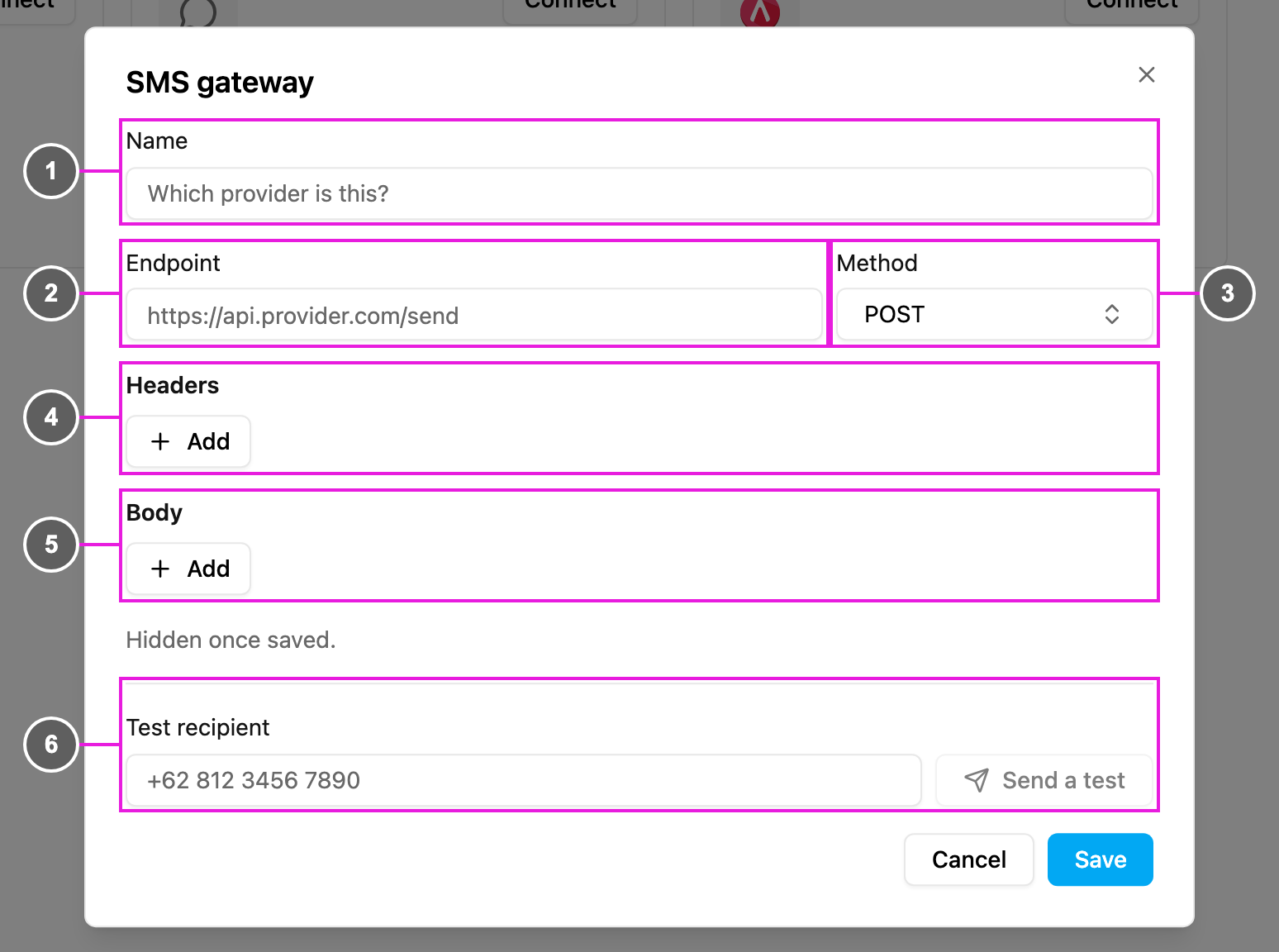
Open **Settings › Integration** and click **Connect** on the **SMS gateway** card.
1. **Name**: which provider this is, for example the provider's name. Required.
2. **Endpoint**: the full `http://` or `https://` address the app sends each SMS to, as given in your provider's API documentation.
3. **Method**: **POST** (the default), **GET** or **PUT**. With **GET**, the body fields are sent as query parameters on the endpoint.
4. **Headers**: click **Add** for each header your provider needs, such as an API key or `Content-Type`. Each row has a **Name** and a **Value**.
5. **Body**: click **Add** for each field the request carries, such as the recipient, the message and a sender ID.
6. **Test recipient**: a phone number to receive a test message, then **Send a test**.
Click **Save**. The card shows **Connected**.
### Fill in the recipient and the message
In any header or body **Value**, write these placeholders where your provider expects the details of each message. They're replaced every time an SMS is sent:
| Placeholder | Replaced with |
| - | - |
| `{recipient}` | The phone number the SMS goes to. |
| `{message}` | The text of the SMS. |
For example, a provider that expects `to`, `text` and `from` fields gets three body rows:
| Name | Value |
| - | - |
| `to` | `{recipient}` |
| `text` | `{message}` |
| `from` | `YOURBRAND` |
The body is sent as JSON. If your provider expects a form instead, add a header **Name** `Content-Type` with **Value** `application/x-www-form-urlencoded`.
### Keep keys hidden
Each header and body row has a **Secret** checkbox. Tick it for API keys, passwords and tokens: the value is masked while you type and is **hidden once saved**, so nobody can read it back from the dialog later. To change a secret, type the new value.
Use **Remove** to delete a row.
## Send a test
Before you rely on the gateway, check that your provider accepts the request:
1. Type a phone number in **Test recipient**, for example `+62 812 3456 7890`.
2. Click **Send a test**. The button works once **Endpoint** is a full `http://` or `https://` address.
The test uses what is in the dialog right now, so you can test before saving. *Test message sent to …* means your provider accepted it; check that the phone received it. *The test message did not go through* means your provider refused the request: check the endpoint, method, headers and body against your provider's documentation.
## Change or disconnect the gateway
* Click **Edit** on the card to change any field, then **Save**. The toast *SMS gateway updated* confirms it.
* Click **Disconnect** and confirm to remove the gateway. SMS goes back through the built-in provider and uses **Credits** again. Automations don't need to change.
This documentation is built and hosted on [Mintlify](https://mintlify.com), a developer documentation platform.