

- Pull into the app: a Sales Order created in Accurate becomes a task automatically.
- Send to Accurate: finishing that task creates a Delivery Order in Accurate.
- A Sales Order is created in Accurate.
- It is pulled into the app as a task.
- The task is done and delivered in the field app.
- A Delivery Order is sent back to Accurate, linked to the Sales Order.
Required permission:
- View integration
- Create integration (to connect and to add rules)
- Edit integration (to turn rules on or off and repair them)
- Delete integration (to delete rules and disconnect)
The Accurate card is offered to selected accounts only. If you don’t see it on Settings › Integration, contact support.
Before you begin
- An Accurate Online account: the cloud version, which provides the Open API this integration uses.
- At least one business (data usaha) set up in your Accurate Online account.
- Create integration permission in the web app.
- One Accurate account per organization: an Accurate account holds a single active connection at a time, so connecting it to a second organization ends the first connection. Use a separate Accurate account for each organization you want to sync.
Step 1: Connect your Accurate account
- Open Settings › Integration.
- On the Accurate card, click Connect.
- You’re taken to Accurate’s authorization page. Sign in with your Accurate credentials and click Grant Access.
- Accurate sends you back to Settings › Integration. The card now shows Connected.
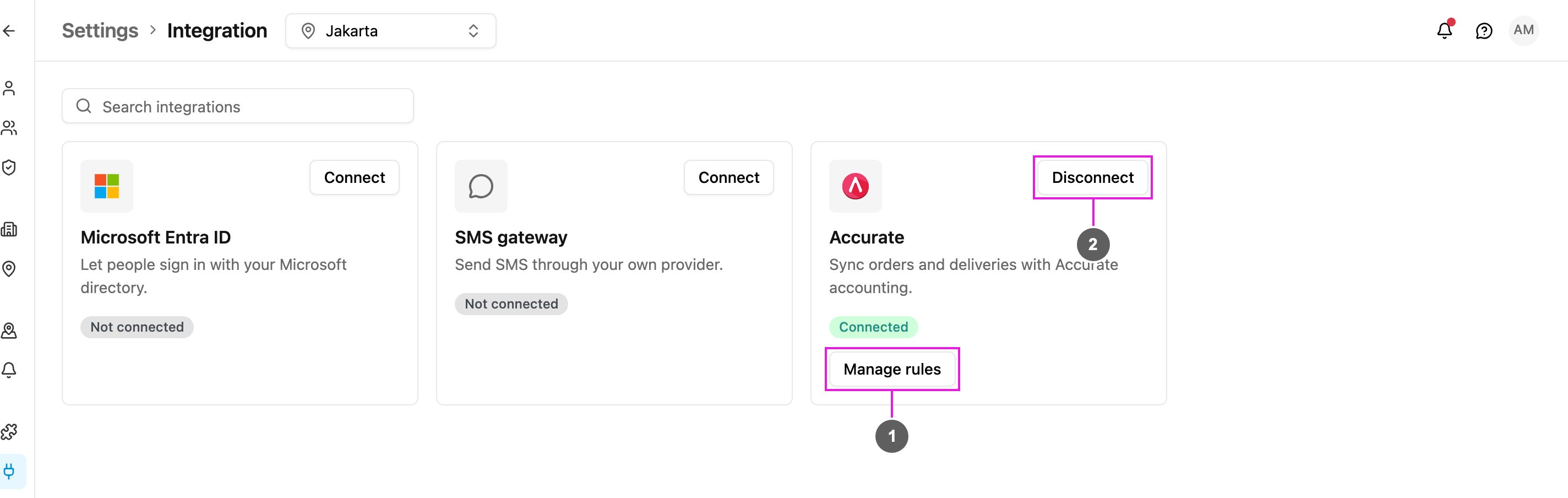
- Manage rules: opens Accurate rules, where you add, turn on or off, repair and delete the sync rules.
- Disconnect: ends the connection. See Disconnect.
Step 2: Open the rules
Click Manage rules on the card.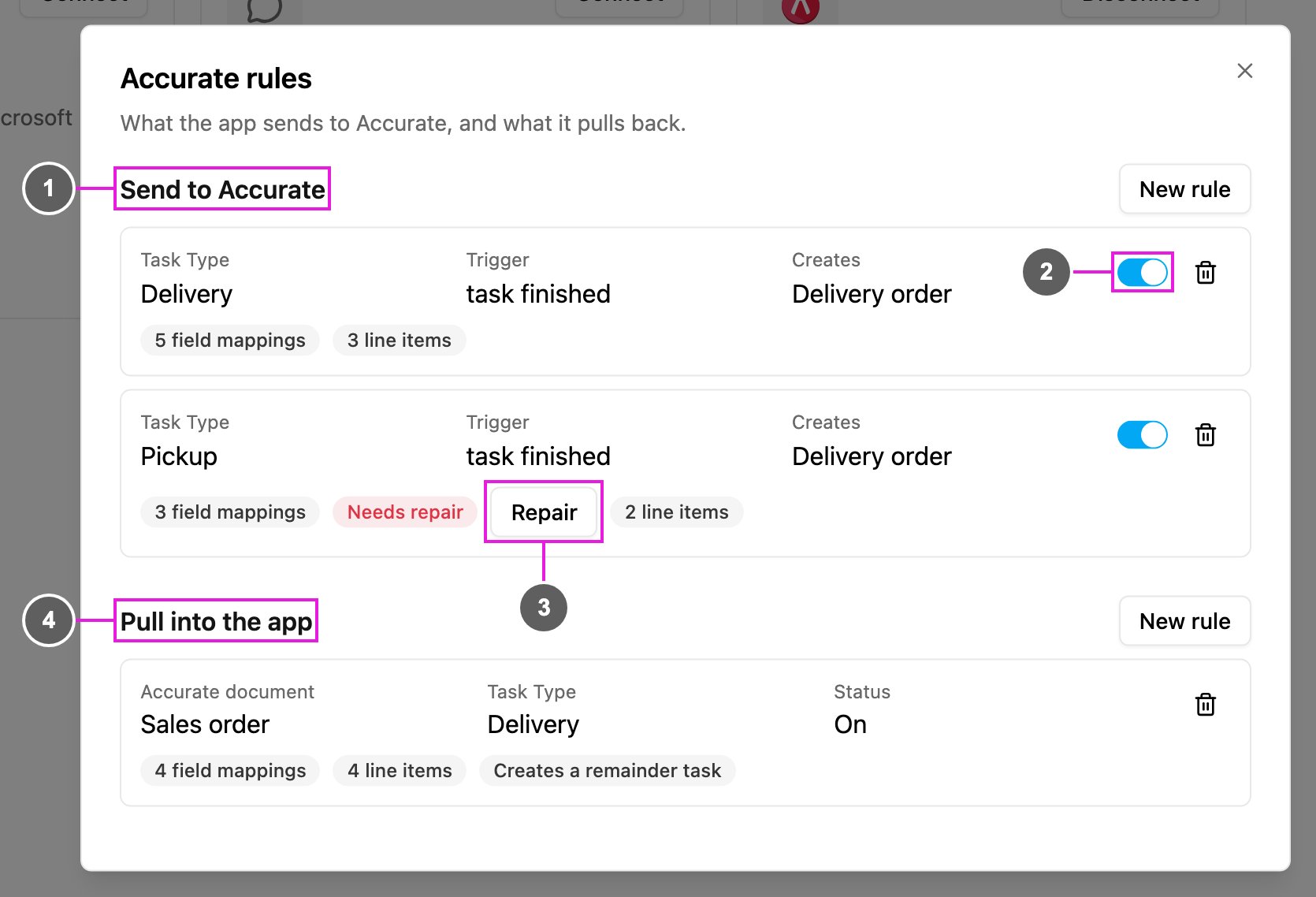
- Send to Accurate: rules that create a record in Accurate when something happens to a task. Each rule shows its Task Type, Trigger and what it Creates, with badges for the number of field mappings and line items. No rules send anything to Accurate yet. means there are none.
- On / off switch: turns a send rule on or off without deleting it. The toast Rule turned on. or Rule turned off. confirms it.
- Needs repair and Repair: every send rule runs through an automation the app creates for it. If that automation was edited or deleted on the Automation page, the rule shows Needs repair. Click Repair and it is rebuilt (Rule repaired.).
- Pull into the app: rules that turn an Accurate document into a task. Each rule shows its Accurate document, Task Type and Status (On or Off), with badges for field mappings, line items and Creates a remainder task when that option is on. No rules pull anything from Accurate yet. means there are none.
Step 3: Add a rule that pulls Sales Orders in
Click New rule under Pull into the app.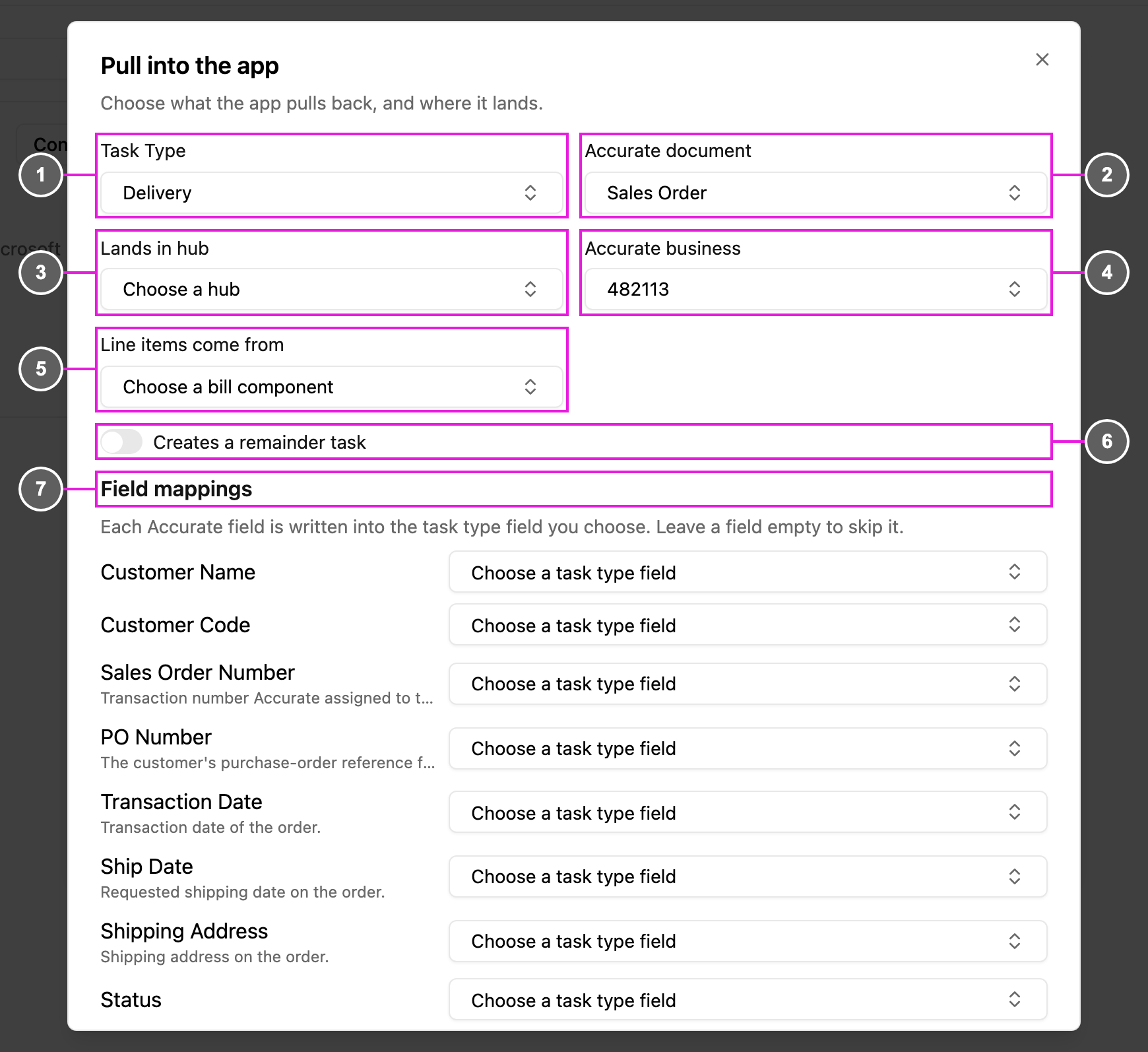
- Task Type: the task type new tasks are created in.
- Accurate document: Sales Order.
- Lands in hub: the hub the new tasks belong to.
- Accurate business: the business the Sales Orders come from.
- Line items come from: the Bill component that receives the order’s item rows. See Bill.
- Creates a remainder task: turn this on and a Sales Order that is only partly delivered raises a new task for what’s still owed. See Partial delivery and the remainder task.
- Field mappings: every field the Sales Order offers gets a row, such as Customer Name, Customer Code, Sales Order Number, PO Number, Transaction Date, Ship Date, Shipping Address and Status. For each one you want, choose the task type field it is written into. Leave a row empty to skip it.
qty.
Click Save. The toast Rule created. confirms it.
The same Accurate document and business can feed several task types. One Sales Order then creates one task in each of them.
Step 4: Add a rule that sends Delivery Orders back
Click New rule under Send to Accurate.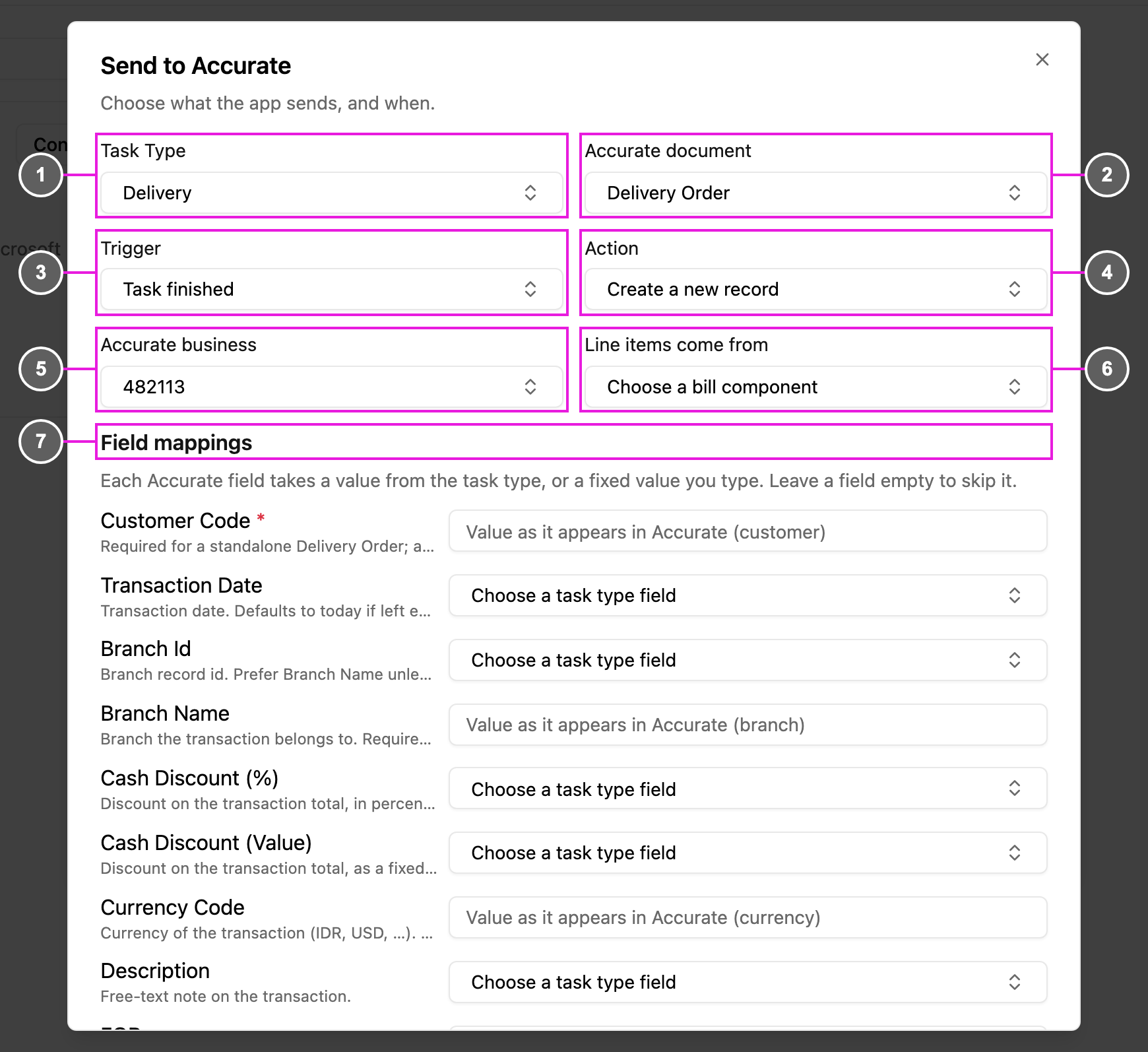
- Task Type: the task type whose tasks are sent.
- Accurate document: Delivery Order.
- Trigger: when the record is sent: Task created, Task assigned or Task finished. Use Task finished so the record carries what the driver actually delivered.
- Action: Create a new record or Update an existing record.
- Accurate business: the business the record is created in.
- Line items come from: the Bill component whose rows become the Delivery Order’s items.
- Field mappings: every Accurate field the Delivery Order accepts gets a row, with a short note under its name. Fields marked * are required by Accurate.
- Choose a task type field: the value is taken from a field of the task type, for example Transaction Date or Description.
- Value as it appears in Accurate (…): fields that point at a record that already exists in Accurate, such as Customer Code, Branch Name, Currency Code, Payment Term, Carrier and FOB, take a fixed value. Type it exactly as it appears in Accurate, for example the customer’s code (not its name).
A Delivery Order sent for a task that was pulled in from a Sales Order links back to that Sales Order and advances its fulfilment. Its customer and branch are taken from the Sales Order itself, so you don’t need to map them for this round trip; a fixed Customer Code is only used for tasks that didn’t come from a Sales Order. If the task’s Bill contains a row that wasn’t on the original Sales Order, that row is added to the Sales Order first, which can increase the order’s total.
Branch matters when your Accurate business has more than one branch: Accurate requires a branch on a Delivery Order in a multi-branch company. For a single-branch company it isn’t needed.
Which fields can be mapped
Accurate stores five kinds of value: text, whole number, money, true/false and date. Map a field only if it holds one such value. The rules are the same in both directions. Input components, by their type:
Other components:
Components that hold a file or a picture, group other components, or only display something have no value for Accurate to record. See Components.
Syncing happens automatically
Send to Accurate. Saving a send rule creates an automation in the background, named [Accurate] Task Type → Document, for example [Accurate] Delivery → Delivery Order. You can see it on the Automation page, but you don’t need to manage it. From then on, every task of that task type that reaches the trigger is sent to Accurate. Any Bill item that doesn’t exist in Accurate yet is created there when the task is sent, so you don’t need to create every product in Accurate first. Pull into the app. Once a pull rule exists, Accurate tells the app whenever a Sales Order in that business changes:- Created: a task is created in each mapped task type, in the hub you chose.
- Edited: the linked task is updated. No duplicate is created, however many times the order changes.
- Deleted: the linked task is deleted.
Partial delivery and the remainder task
A driver can deliver less than the order asked for: on the Bill, the quantity starts at the ordered amount and can be lowered. The Delivery Order records what was actually handed over, and the Sales Order keeps the difference outstanding. With Creates a remainder task on, the app raises a new task for that outstanding quantity as soon as the first task finishes. It carries the same customer, address and mappings, with a Bill holding only what’s still owed. Deliver it partly again and the cycle repeats, each time leaving a smaller remainder, until the Sales Order is fully delivered and shows Processed in Accurate. With it off, a partial delivery simply closes the task. The Sales Order still shows the outstanding quantity in Accurate, and you decide what happens next.Serial numbers
Some Accurate items are serial-managed: each unit has its own serial or batch number, and Accurate rejects a Delivery Order that doesn’t carry one serial per delivered unit. For send rules that already supply serials, serial matching is forgiving of surplus and strict on shortfalls: extra or unrecognized serials are ignored, and only delivering fewer valid serials than the line’s quantity fails the send, with a message naming the item. A send rule for serial-managed items can’t be set up from this dialog yet; contact support to set one up.Example: a complete round trip
This walkthrough follows one order the whole way.- Two rules. In Manage rules, a task type named Delivery has a pull rule (Sales Order) and a send rule (Delivery Order, trigger Task finished).
- A Sales Order in Accurate. Your sales team creates a Sales Order as usual: a customer, the items and the quantities. It appears in Accurate’s Sales Order list as Waiting on Process.
- The task appears. Within about half a minute a task is in your task list, created from the API, with the customer details already filled in. Its Bill shows every order line with item, quantity and price.
- The field work. The task is assigned and done in the field app like any other. On the Bill page the driver confirms the quantity actually delivered, lowering it when the delivery is partial.
- The task finishes. Finishing the task is what triggers the send.
- The Delivery Order arrives in Accurate. It’s created automatically with the delivered items and quantities, for the same customer and branch as the Sales Order.
- The Sales Order closes itself. Once everything is delivered, the Sales Order shows Processed in Accurate.
- An order raised by your sales team reaches the driver without anyone re-typing it.
- The quantity the driver confirms is the quantity your books record.
- The Sales Order closes itself once delivery is complete, so your accounting stays current on its own.
Managing the integration
Turn a rule on or off
Use the switch on a send rule. A rule that is off keeps its mappings and starts sending again when you turn it back on.Delete a rule
Required permission:
- View integration
- Delete integration
Reconnect
The card shows Reconnect when the connection still exists but needs to be authorized again, for example when a new capability needs a permission your connection predates. Click it, sign in to Accurate and grant access again. Reconnecting refreshes the permissions and keeps every rule. If Accurate ended the connection, for example because the same Accurate account was connected to another organization, the card shows Not connected and Connect. Connect again to resume syncing, and see Before you begin on keeping one Accurate account per organization.Disconnect
Click Disconnect on the card and confirm. Your rules are kept. Disconnecting removes the stored credentials and pauses syncing in both directions; connecting again resumes it. Use Reconnect instead if you only need to refresh permissions. To also remove the app’s access on the Accurate side, open your Accurate account, go to Aplikasi Terhubung (Connected Applications), and remove it there.Good to know
- A task type can carry both directions. The same task type can hold a Sales Order pull rule and a Delivery Order send rule, which is exactly the round trip above.
- Keep rules in step with your task types. If a task type is edited after a rule is saved and a mapped field is gone, replace the rule with one that points at the new field.
- Syncing is go-forward. A rule starts working on the next order or task, so create the rule before the work you want synced.