When you create a task from a task type that has a Subflow component, one or more subtasks are created automatically and linked to the main task. This page explains how main tasks and subtasks appear in the task list, how data is copied between them, and how to assign, move, edit and delete them. To set up a subflow in a task type, see Subflow.
Required permission:
  • View task
  • Create task, Assign task, Move task, Edit task and Delete task, for the matching actions

Main tasks and subtasks

  • Main task: the task created from a task type that has a Subflow component.
  • Subtask: a task created automatically for every Subflow component of the main task’s task type.
  • Field mapping: when the main task is created, its values are copied into the matching fields of each subtask, following the mapping set in the task type builder.
A main task can have one subtask or several, one per Subflow component. A subtask always belongs to a main task; it cannot stand on its own.

How subtasks are created

When you create a task from a task type with Subflow components:
  1. The main task is created like any other task.
  2. For each Subflow component, a subtask is created from the task type the component points to.
  3. Mapped fields are copied from the main task into every subtask.
  4. Each subtask is linked to the main task, so you can see which tasks belong together.
  5. Subtasks take the main task’s assignee, hub, start time and end time. If the main task already has an assignee, the subtasks start as Ongoing.
Subtasks cannot be assigned, moved or scheduled on their own. Make these changes on the main task: they are applied to every subtask.

In the task list

A main task appears as a group: its task type, with the number of tasks below it. Click the arrow (Show the tasks in this group) to show the subtasks under it, and click again to hide them.
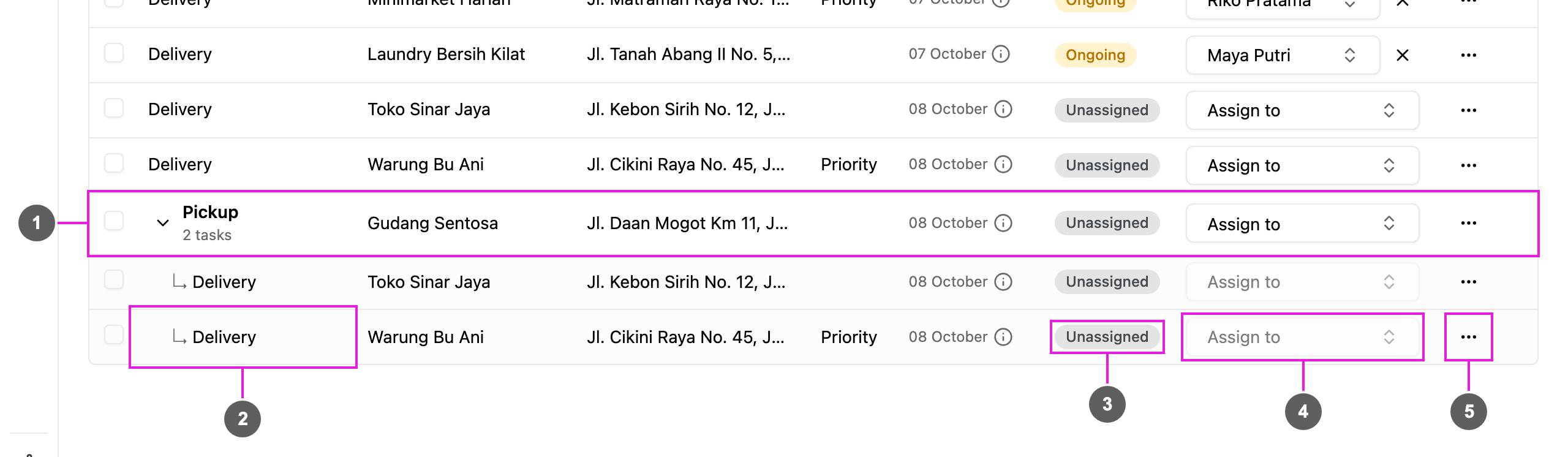
Main task and subtasks
  1. Main task: the main task’s task type and the number of subtasks. Click the arrow to show or hide them. Ticking its box includes all its subtasks in any bulk action.
  2. Subtasks: each subtask with its own task type, shown under the main task with the ↳ marker.
  3. Status: each task’s own status.
  4. Assignee: locked on subtask rows; assign the main task instead.
  5. Task actions: the actions offered depend on whether the row is a main task or a subtask.
On a narrow screen, the list shows cards; a main task is a card group you tap to show or hide its subtasks.

Bulk actions

Ticking a main task includes every subtask in the action. The bar above the list offers Edit time, Assign, Unassign, Move and Delete: the action runs on the main task first and is then applied to its subtasks. The rules for each are below.

Main task details

Open a main task to see its own data and its subtasks.
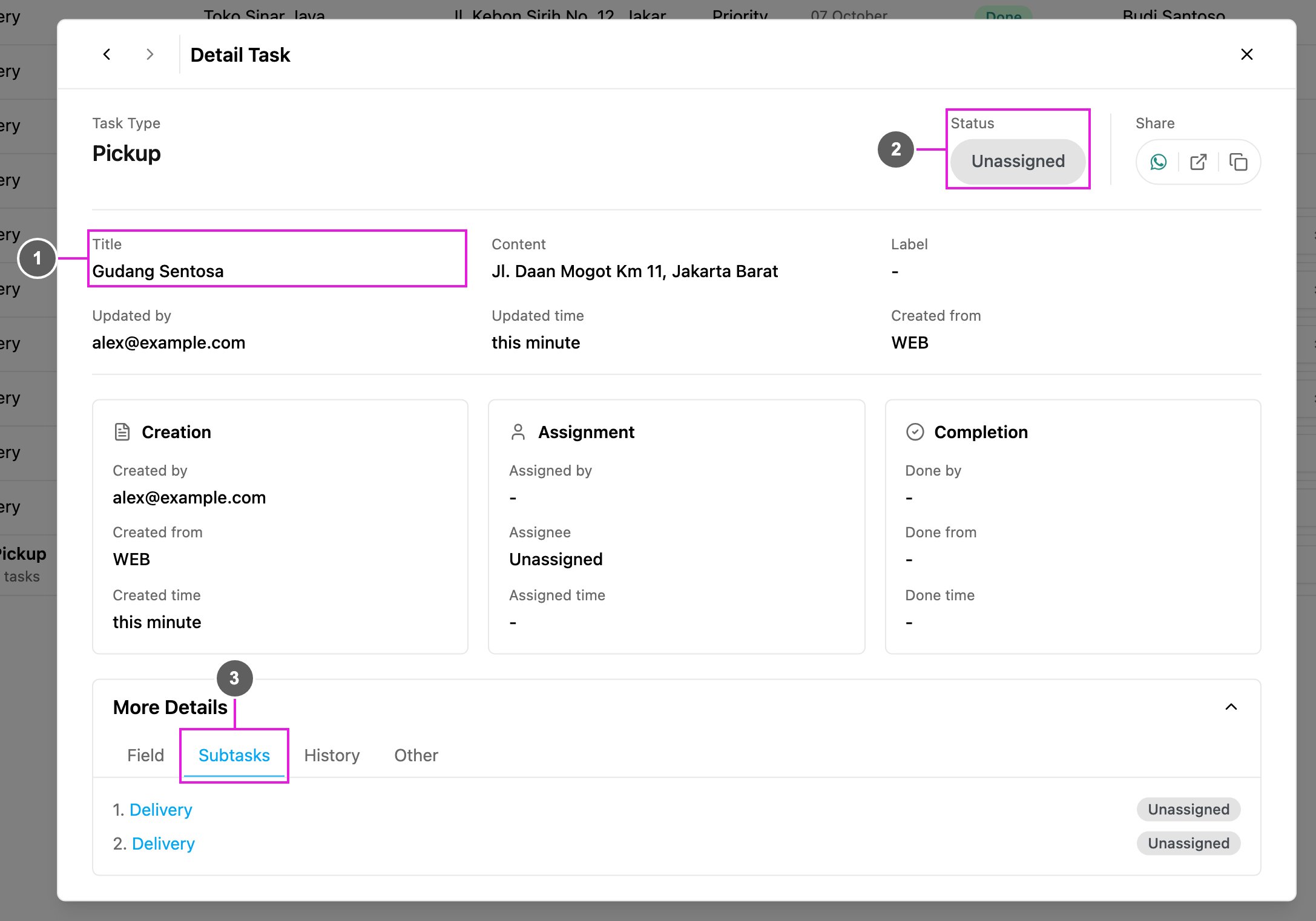
Main task detail
  1. Overview: the main task’s title, content, label and other values.
  2. Status: the main task’s own status.
  3. Subtasks: in More Details, the Subtasks tab lists every subtask of the main task. Click one to open its details.
The Field, History and Other tabs and the Creation, Assignment and Completion cards work as on any other task. A subtask opens as Subtask Detail. View master task jumps back to its main task. Fields mapped from the main task are already filled in.

Assigning a main task

Assigning a main task assigns every subtask too. A subtask cannot be assigned on its own: its Assignee cell is locked. If you change the main task’s assignee later, the new assignee replaces the old one on every subtask.
Once any subtask is Done, the main task can no longer be reassigned. Change the assignee before any subtask is finished.

Moving a main task

Moving a main task to another hub moves every subtask too. It works only when the main task and every subtask are Unassigned.
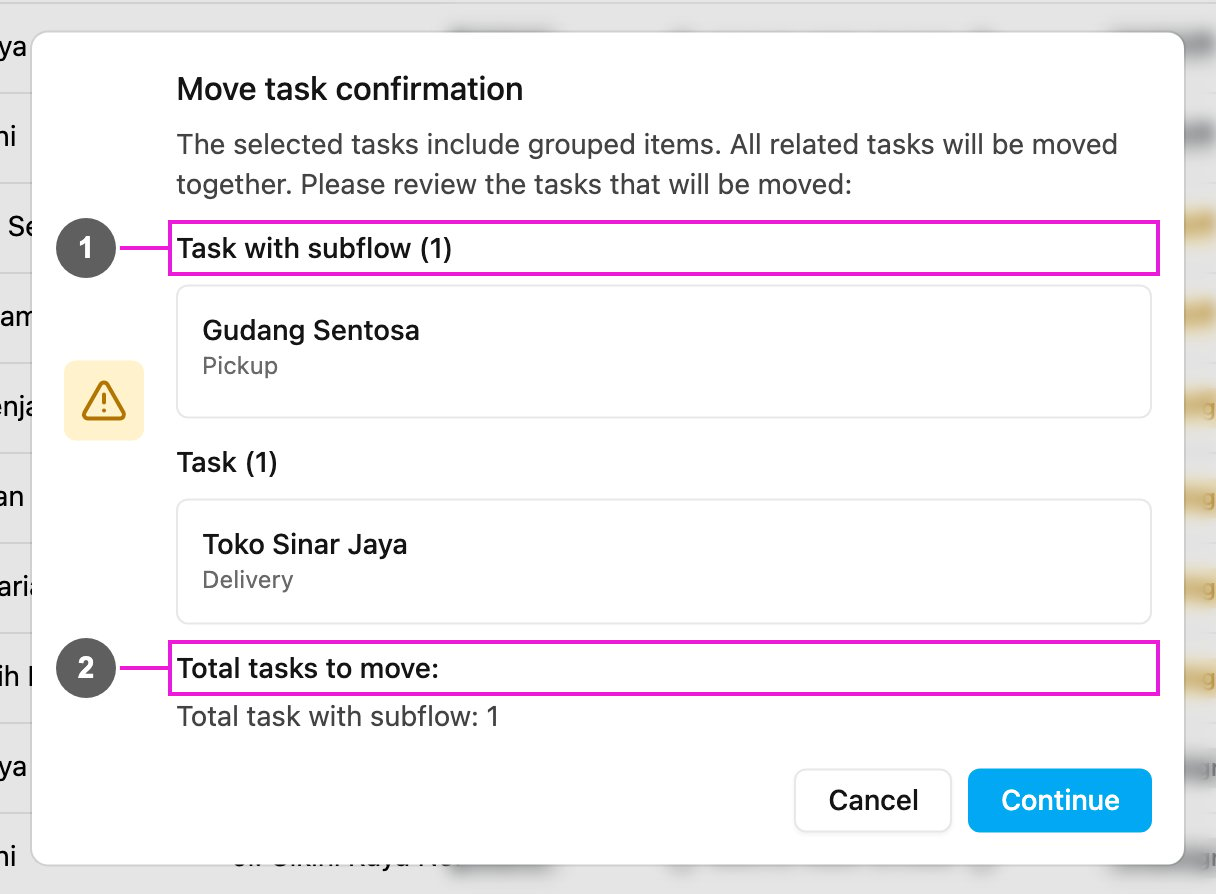
Move task confirmation
  1. Task with subflow: the main tasks and every subtask that move together. Check that nothing else is included.
  2. Total tasks to move: how many main tasks (Total task with subflow) and subtasks (Total subflow) will move when you click Continue.
If the main task or any subtask is Ongoing or Done, the move is refused with a message asking you to unassign the related tasks first.

Editing

A main task can be edited like any other task. Its assignee, start time and end time are applied to every subtask. Its other fields, such as the customer name or order number, are saved on the main task only. A subtask has no Edit of its own: its assignee, time window and hub always come from the main task, and its own fields are filled in by the field worker when they do it.

Deleting

Deleting a main task deletes every subtask too. Subflow delete confirmation lists every task that will be removed. Click Yes, keep going to delete them.
A main task cannot be deleted once any of its subtasks is Done: finished subtasks are kept as part of the task history.
A subtask cannot be deleted on its own: delete it together with its main task.

Frequently asked questions

Can I assign a different person to a subtask? No. A subtask always has the same assignee as its main task. Change the main task’s assignee and every subtask follows. Why are some actions missing on a subtask row? Subtasks cannot be assigned, moved, scheduled, edited or deleted on their own. Use the main task. What happens to the main task when a subtask is done? The subtask becomes Done, but the main task keeps its own status until it is done itself. When the subflow is required, the main task cannot be finished until every required subtask is done. Can a subtask have a subflow of its own? No. A task type that already has a Subflow component cannot be the target of another subflow: subflows are one level deep. I finished a subtask by mistake. Can I delete it and start again? No. A done subtask cannot be deleted, and its main task cannot be deleted either. Can I move just one subtask to another hub? No. Subtasks move with their main task, and only while the main task and all its subtasks are unassigned.