

Required permission:
- View automation
- Create automation
Email is offered only to accounts with the official sender. Other accounts see WhatsApp (Fonnte) only.
Set it up
Choose Automation Type › Notification, then Notification Channel › Email.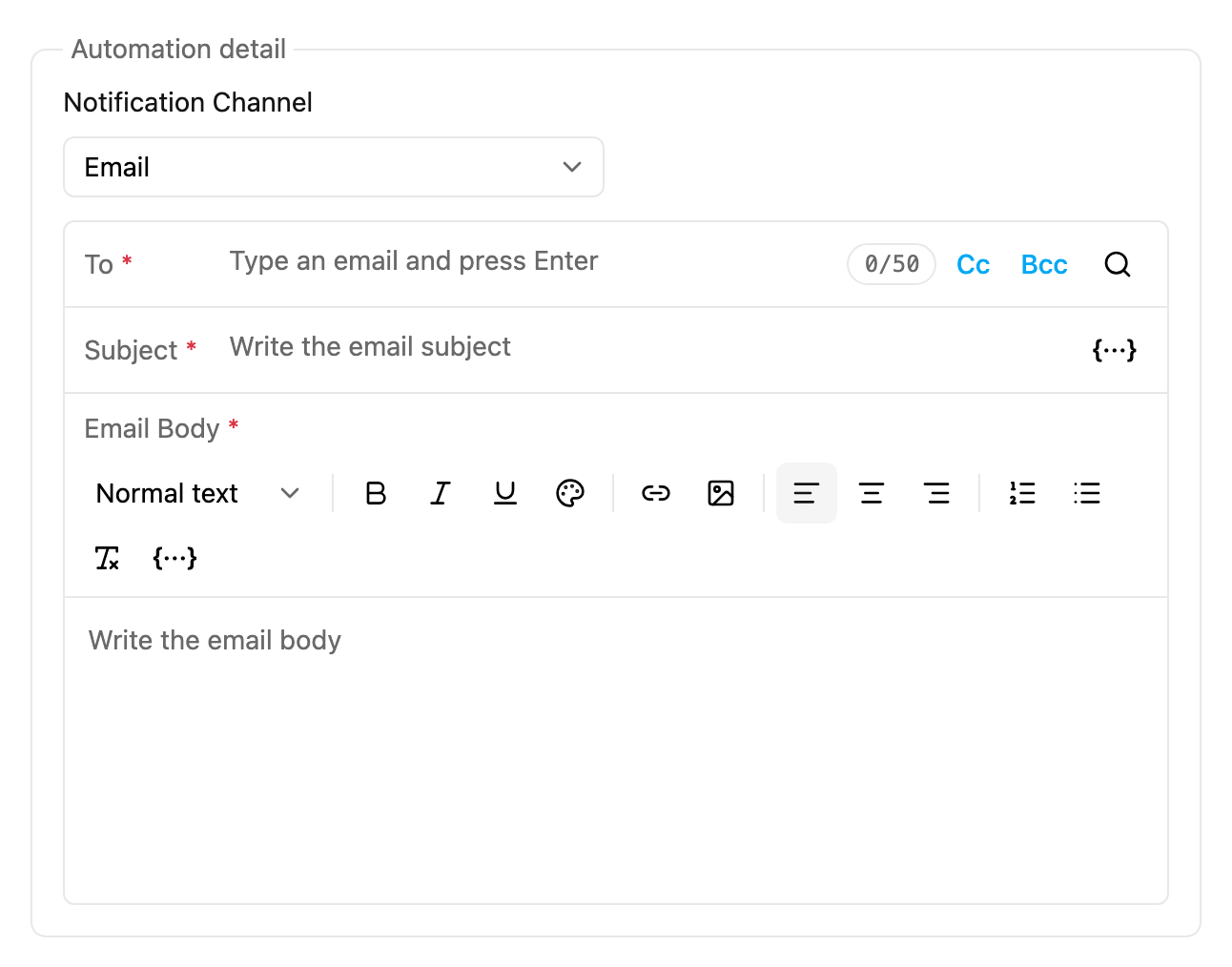
- To: required. At least one recipient.
- 0/50: how many recipients are set, out of the maximum of 50 (To, Cc and Bcc together). It changes colour as you approach the limit.
- Cc and Bcc: click to show the Cc and Bcc rows. Both are optional.
- Search icon (recipient from task field): add a recipient taken from a field of the task.
- Subject: required. Plain text; the {…} button inserts a variable.
- Email Body: required. A rich-text editor with a formatting toolbar.
Recipients
Each row (To, Cc, Bcc) takes two kinds of recipient:- Fixed address: type an email and press Enter. You can paste several addresses separated by commas, semicolons or spaces; each becomes its own recipient. Invalid addresses are flagged with “Invalid email address”.
- Recipient from Task Field: click the search icon and pick a field of the task type. When the email is sent, the task’s value for that field is used as the address. Only plain text input fields are offered; select, number, date, phone, address and other fields never appear, even if their value looks like an email. The tooltip reads “Add a recipient from a task field (text input only).”
- To needs at least one recipient: a fixed address, a task field, or both.
- 50 recipients at most, counting To, Cc and Bcc together. Once the limit is reached, no more can be added (“Recipient limit reached: maximum 50”). The limit is checked again when the email is sent.
- No duplicates across rows. If the same address ends up in more than one row, it’s kept only in the highest row, in the order To, Cc, Bcc, and it’s charged once.
Subject and body
The Email Body toolbar offers:Variables
Click {…} in the Subject or the body toolbar, search, and pick a variable. It’s inserted as{{token}} and replaced with the task’s value when the email is sent. Variables show as highlighted chips; a token the system doesn’t recognise is marked “Unknown variable — it will be sent as typed.”
Task variables:
Below them, the picker lists the fields of the task type, grouped by page and named by their titles. Fields that hold a single value (text, number, date, time, select, phone number, address, currency, URL, coordinate) are offered. Bill, list, photo, video, voice, capture, signature, timer, subpage, subflow and view components are not.
Example:
- Subject:
Your delivery {{title}} is on its way - Body:
Images
Paste an image into the body, or click Insert image and pick a file. It shows inline straight away. Images are uploaded only when you click Submit; if you close the form without saving, nothing is uploaded.- Formats: JPG, PNG, GIF and WEBP. Other types are refused (“Unsupported image type”).
- Size: up to 5 MB per image (“Image is too large”).
- If an upload fails, the automation isn’t saved; try again.
Cost
Each email uses your organization’s Credits balance, the same balance used by WhatsApp, SMS and OTP messages: 1 credit per unique recipient, after duplicates are removed. Organizations on an unmetered licence aren’t charged and always send to everyone. When the email is sent, the balance is checked:- Enough credit: everyone receives it.
- Credit for only some recipients: it’s sent to as many as the balance allows, in the order To, Cc, Bcc; the rest are dropped and the log notes “insufficient credit”.
- No credit: nothing is sent.
- The balance can’t be checked: nothing is sent, and the log notes “Could not verify email credit balance”. You’re never charged for a send that couldn’t be confirmed.